






Nantwich sits at the heart of South Cheshire, surrounded by villages, farms, and rural communities. The healthcare professionals who serve this area work in GP surgeries, dental practices, care homes, community clinics, and domiciliary care services that cover a wide geographical patch. Many of their patients live in areas where the nearest hospital is a considerable distance away and ambulance response times can be longer than in urban centres.
That reality makes life support training not just important but critical. When a patient suffers a cardiac arrest in a rural GP surgery or a resident collapses in a care home on the outskirts of Nantwich, the clinical team on site may be the only trained responders for a significant period. The quality of the life support they provide in those minutes directly determines whether the patient survives.
We are PCT Services, and we deliver Resuscitation Council UK accredited life support training from our training centre at First Floor, 2 Queen Street in Northwich, about a 15 minute drive from Nantwich. We also deliver on-site training at healthcare settings across the area.
The rural challenge
In an urban hospital, a cardiac arrest triggers an immediate response from a resuscitation team that arrives within minutes. In a rural GP surgery, the response depends entirely on the staff present. There is no crash team down the corridor. There is no anaesthetist on call in the next room. There is the practice nurse, the GP, and possibly a healthcare assistant. That is the team, and they need to manage the situation until the ambulance arrives.
The same applies to care homes in and around Nantwich. Elderly residents are at higher risk of cardiac events, respiratory emergencies, and rapid deterioration. The nursing staff on duty, sometimes just one or two people during evening and weekend shifts, need to be able to initiate and sustain effective life support without delay.
For domiciliary care workers who visit patients in their homes across the South Cheshire countryside, the challenge is even more acute. If a patient collapses during a home visit, the carer is the only person present, and help may be some distance away. Basic life support skills are not optional in that scenario. They are the difference between life and death.
Basic Life Support: essential for every member of the team
Our BLS course follows the latest Resuscitation Council UK guidelines and covers recognition of cardiac arrest, high-quality chest compressions, rescue breathing, AED use, and choking management. It is a two hour course designed as an annual refresher.
For rural healthcare providers near Nantwich, BLS should be completed by every member of staff. Clinical and non-clinical. The receptionist who is the first point of contact when a patient walks through the door. The healthcare assistant who is often alone with patients during routine observations. The practice manager who might be the only person in the building during a quiet period. Everyone.
BLS gives your whole team the ability to start effective resuscitation immediately, regardless of who is present when the emergency happens. In a rural setting where backup may take longer to arrive, the quality and speed of that initial response matters even more.
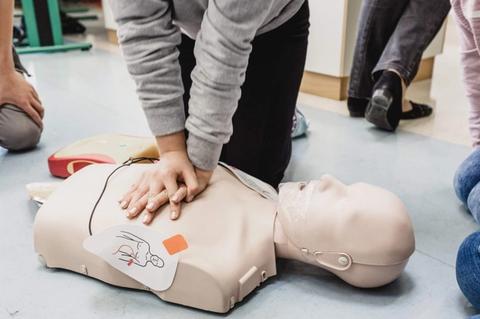
Basic Life Support Training (BLS) CPD Accredited
This Basic Life Support is ideal for healthcare professionals who require Level 2 Resuscitation Core Skills Training Framework (CSTF). This CPD accredited course provides essential knowledge and practical skills to competently recognise a cardiac arrest and commence basic life support in adults, children and infants. It also covers safe application of an AED (Automatic External Defibrillator), how to use a Bag-Valve-Mask (BVM), administration of oxygen, and the initial assessment and management of anaphylaxis and choking.
Northwich Training Centre, Northwich
4 spots left · 3 dates available
Enhanced Immediate Life Support: for clinical staff
eILS goes beyond basic CPR. It covers airway management using adjuncts, bag-valve-mask ventilation, recognition and initial management of peri-arrest arrhythmias, and a structured approach to the deteriorating patient using the ABCDE framework.
The eILS course costs £180 per person and combines e-learning with a full day of practical, simulation-based training.
For GPs, practice nurses, and senior care home staff in the Nantwich area, eILS provides the skills to manage a medical emergency at a higher level. When a patient is deteriorating but has not yet arrested, eILS-trained staff can assess systematically, intervene with airway management, and provide a structured handover to the ambulance crew when they arrive. This is particularly valuable in rural settings where the time between recognising deterioration and the arrival of emergency services can be longer.
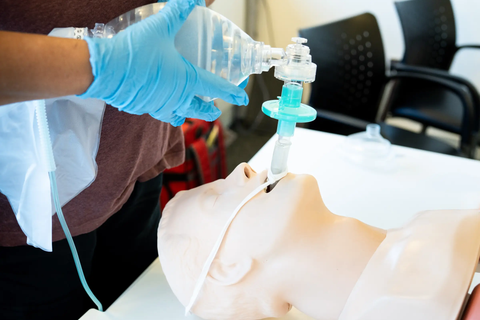
Immediate Life Support Training (eILS)
The Immediate Life Support course is a specialised course designed to equip healthcare professionals with a variety of skills, from managing a deteriorating adult, identifying causes of deterioration and treating cardiorespiratory arrest in adults, to developing team leadership skills and understanding what it takes to be an effective team member in an emergency.
Northwich Training Centre, Northwich
Fully booked
ePILS: for those working with children
For healthcare professionals in Nantwich who work with children, whether in GP surgeries that see paediatric patients, children's community services, or health visiting, our ePILS course covers paediatric and neonatal life support. It costs £150 per person and focuses on the specific techniques and considerations for managing life-threatening emergencies in infants and children.
Paediatric emergencies are rare in community settings, but when they happen, the response needs to be immediate and technically different from adult life support. ePILS ensures that healthcare professionals who encounter children in their practice have the specific skills needed.
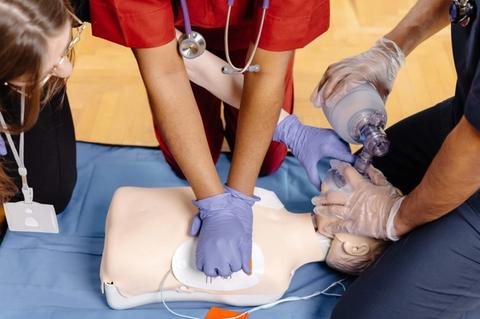
Paediatric Immediate Life Support Training (ePILS)
The Paediatric Immediate Life Support course is a specialised half-day training programme designed to equip healthcare professionals with critical skills for managing paediatric emergencies. This Resuscitation Council accredited course focuses on the ABCDE approach, immediate life support techniques, and team leadership skills essential for treating seriously ill or deteriorating children until expert help arrives.
Building resilience in rural teams
The most effective approach for rural healthcare providers near Nantwich is a layered training plan. Every member of staff completes BLS annually. This creates a baseline of competence across the entire team. Clinical staff then complete eILS to provide a higher level of capability. Staff who work with children add ePILS.
This layered approach means that no matter what combination of staff is on duty, no matter what time of day the emergency happens, there is always someone who can start effective life support immediately and someone who can escalate to more advanced interventions.
For care homes with shift patterns, this is particularly important. The team on a night shift may be smaller than the day team, but the risk of a medical emergency does not reduce. Making sure that every shift includes BLS-trained staff, and ideally at least one eILS-trained nurse, is the minimum standard that rural care providers should aim for.
Training options
We run scheduled BLS and eILS courses throughout the year at our training centre at First Floor, 2 Queen Street in Northwich. Check the live dates on our Basic Life Support page, our eILS page, or our ePILS page.
For healthcare teams near Nantwich who want to train together, on-site delivery is often the most practical option, especially for BLS refreshers. We come to your surgery, practice, or care home, bring all the equipment, and train your team in batches so that patient care is not disrupted. On-site training also lets us discuss your specific emergency equipment, your AED location, and your emergency procedures.
Book your training
If you are a practice manager, care home manager, or healthcare professional in the Nantwich area, check the upcoming dates on our course pages or give us a call on 07958 915146 to arrange training for your team. In rural healthcare, the team on site is often the only team. Make sure they are ready.
Topics

Written by
Founder
- Registered Nurse / Specialist Practitioner Emergency Care
- Advanced Paediatric Life Support Instructor
- Immediate Life Support Instructor
- Independent Non Medical Prescriber
- Post Graduate Certificate in Education
I have practiced as a registered nurse for over 34 years, 29 within a senior nursing position within Emergency Care and as a part time lecturer at the University of Manchester. I am a Resuscitation Council (UK) and Advanced Life Support Group Instructor for Advanced Paediatric…
Read more about Jennie

