














You have probably seen baby first aid courses advertised and thought about booking one. Maybe you have wondered whether it is worth the time, whether you would learn anything you do not already know, or what actually happens during the session. This post is for Congleton parents who are curious about our Baby and Toddler First Aid course and want to know exactly what the three hours covers before they commit.
The short answer is that you learn the practical skills to deal with the emergencies that are most common and most dangerous for babies and young children. The slightly longer answer is that you leave feeling like a different parent, one who knows what to do instead of hoping it never happens.
We are PCT Services, and we run this course at our training centre at First Floor, 2 Queen Street in Northwich, about a 20 minute drive from Congleton. It costs £42 per person, it lasts three hours, and you receive a certificate valid for one year.
What the three hours actually look like
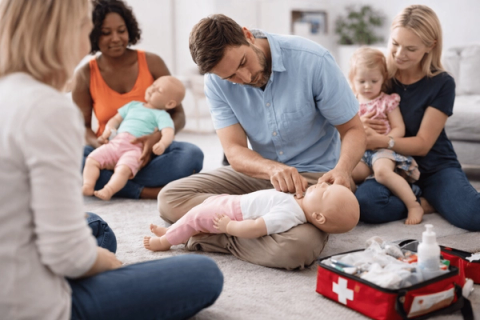
The course is entirely practical. There is no lecture, no PowerPoint presentation, no sitting in rows taking notes. You sit at a table with an infant manikin in front of you, and from the first minute, you are learning by doing.
The instructor talks you through each scenario, demonstrates the technique, and then you practise it yourself. You practise multiple times until it feels natural. The instructor watches, corrects, and encourages. Questions are welcome at any point, and the atmosphere is relaxed because everyone in the room is in the same position: a parent or carer who wants to be prepared.
Here is what you cover.
Choking
This is the one that brings most parents through the door, especially parents who are about to start or who have recently started weaning. You learn to recognise the difference between gagging, which is normal and safe, and choking, which is an emergency. You learn exactly how to position an infant face-down along your forearm and deliver back blows. You learn chest thrusts for babies and abdominal thrusts for older children. You practise on the manikin until the movement is automatic.
Parents consistently tell us this is the skill they are most relieved to have. Choking happens fast, and the window for effective intervention is short. Knowing the technique before it happens is the only way to respond quickly enough.
CPR for babies and children
You learn how to check whether a baby or child is breathing. You learn how to deliver rescue breaths to an infant, which is different from an adult because you cover both the nose and mouth. You learn chest compressions on a baby using both thumbs placed together rather than the heel of your hand. You learn how the technique changes for an older child. And you practise the full sequence: 30 compressions, 2 breaths, repeat.
This is the skill nobody wants to use, but the one that matters most if you ever need it. A baby in cardiac arrest has minutes, not more. If you do not start CPR immediately, the outcome is likely to be devastating. The course makes sure you can act without hesitation.
Burns and scalds
Hot tea, bath water, the iron, the oven door, hair straighteners. Young children are drawn to exactly the things that burn them. You learn the correct first aid response: cool running water for at least 20 minutes, how to cover the burn, what not to put on it, and when to call 999. You learn to recognise the severity of a burn and understand why some burns that look minor can actually be serious for a small child.
Febrile convulsions
Most parents have never heard of febrile convulsions until they happen. A rapid rise in body temperature triggers a seizure that can look absolutely terrifying. The child may go rigid, shake uncontrollably, lose consciousness, and turn blue around the lips. It is one of the most frightening things a parent can witness.
The course teaches you that febrile convulsions, while terrifying, are usually not dangerous. You learn how to keep the child safe during the seizure, what position to put them in, what not to do, how to manage their temperature afterwards, and when to seek emergency help. Knowing what is happening and what to do transforms a moment of complete panic into a situation you can manage.
Allergic reactions and anaphylaxis
You learn to recognise the signs of an allergic reaction, from mild skin reactions through to full anaphylaxis with breathing difficulties and swelling. You learn what to do at each stage and when to use an adrenaline auto-injector if one is available. For parents of children with known allergies, this section is particularly valuable because it reinforces the confidence to act decisively.
Meningitis
You learn the signs and symptoms of meningitis in babies and young children, including the glass test for the characteristic rash. Early recognition of meningitis can be life-saving because the disease progresses rapidly in young children. Knowing what to look for means you can seek medical help at the earliest possible stage.
Other topics
The course also covers bleeding and wound care, head injuries, and when to call 999 versus when to take the child to A&E versus when to manage the situation at home. These are the everyday decisions that parents face regularly, and having clear guidance makes them easier.
Who should attend
The course is designed for anyone who looks after babies and young children. Parents, grandparents, expectant parents, aunties, uncles, family friends, childminders, nannies, and anyone else who regularly cares for little ones.
No previous first aid experience is needed. The course starts from scratch and builds your skills step by step. Groups are small, a maximum of 12 people, so there is plenty of time for individual attention and questions.
The details
Three hours, £42 per person, certificate valid for one year. We run scheduled courses throughout the year at our training centre at First Floor, 2 Queen Street in Northwich. Check the live dates on our Baby and Toddler First Aid page and book your place.
For Congleton parent groups, NCT groups, or community groups who want to book as a group, give us a call on 07958 915146 and we can discuss a session that works for you.
Three hours. Forty-two pounds. The skills to save your child's life. Every parent in Congleton should do this course.
Baby & Toddler First Aid
Gain confidence to handle emergencies with your baby or toddler. Learn essential first aid skills from a trainer who is a Registered Nurse with many years of clinical experience within Emergency Departments who trains Advanced Paediatric Life Support to medical and nursing staff in acute hospital environments.
Northwich Training Centre, Northwich
Fully booked · 3 dates available
Topics

Written by
Founder
- Registered Nurse / Specialist Practitioner Emergency Care
- Advanced Paediatric Life Support Instructor
- Immediate Life Support Instructor
- Independent Non Medical Prescriber
- Post Graduate Certificate in Education
I have practiced as a registered nurse for over 34 years, 29 within a senior nursing position within Emergency Care and as a part time lecturer at the University of Manchester. I am a Resuscitation Council (UK) and Advanced Life Support Group Instructor for Advanced Paediatric…
Read more about Jennie

