






Care homes in Winsford look after residents who are elderly, often frail, and frequently living with multiple long-term health conditions. Heart disease, respiratory conditions, diabetes, dementia, and the general fragility that comes with advanced age all mean that medical emergencies can happen at any time. A resident can go from stable to critical in minutes, and the staff on duty are the only people who can respond until the ambulance arrives.
Basic Life Support training is not an optional extra for care home staff. It is an essential, non-negotiable skill that every member of the team needs. Not just the nurses. Not just the senior carers. Everyone. Because cardiac arrests, choking incidents, and unresponsive patients do not wait for the most qualified person to be nearby.
We are PCT Services, and we deliver Resuscitation Council UK accredited BLS training from our training centre at First Floor, 2 Queen Street in Northwich, about a 10 minute drive from Winsford. We also deliver on-site training at care homes across the area.
Why every care home staff member needs BLS
In a hospital, a cardiac arrest triggers a rapid response from a dedicated resuscitation team. In a care home, the response comes from whoever is on duty. During a night shift, that might be two carers and a nurse covering an entire building. During the evening handover, staff might be spread across different floors and different wings. During mealtimes, a choking incident can happen in a dining room full of residents.
The person closest to the emergency is the person who must act. If that person is a healthcare assistant who has never practised CPR on a manikin, the outcome is likely to be poor. If that same healthcare assistant has completed annual BLS training and can start effective compressions within seconds, the chances of survival improve dramatically.
The chain of survival begins with early recognition and early CPR. In a care home, you are the first link in that chain. There is no one else.
What BLS training covers
Our BLS course follows the latest Resuscitation Council UK guidelines and covers everything your care home team needs.
Recognition of cardiac arrest. Knowing the difference between a resident who is sleeping, a resident who has fainted, and a resident who has no pulse and is not breathing. Speed of recognition is critical, and the course trains your staff to assess quickly and accurately.
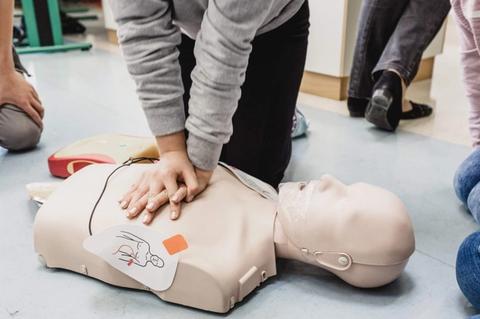
High-quality chest compressions. Practised on manikins with real-time feedback that shows whether the depth, rate, and recoil of each compression are correct. This is the core skill that keeps blood circulating to the brain and vital organs while waiting for the ambulance.
Rescue breathing. How to deliver effective breaths using a pocket mask or bag-valve-mask. For elderly residents, effective ventilation can be the difference between a reversible event and one that is not.
AED use. How to safely and confidently use an automated external defibrillator. If your care home has an AED, every member of staff should know where it is, how to retrieve it, and how to apply it. If your care home does not have one, the course will help you understand why you should consider getting one.
Choking management. How to recognise and respond to choking in adults, including residents who may have swallowing difficulties due to stroke, dementia, or general frailty. Mealtimes in care homes are a common setting for choking incidents, and the staff supervising mealtimes need to be able to act immediately.
The course lasts two hours, which makes it practical to run during a working day without shutting down the care home.
Basic Life Support Training (BLS)
This Basic Life Support is ideal for healthcare professionals who require Level 2 Resuscitation Core Skills Training Framework (CSTF). This CPD accredited course provides essential knowledge and practical skills to competently recognise a cardiac arrest and commence basic life support in adults, children and infants. It also covers safe application of an AED (Automatic External Defibrillator), how to use a Bag-Valve-Mask (BVM), administration of oxygen, and the initial assessment and management of anaphylaxis and choking.
Northwich Training Centre, Northwich
4 spots left · 3 dates available
Annual refreshers are essential
BLS is a perishable skill. The Resuscitation Council UK recommends annual refreshers for all healthcare staff, and the CQC expects to see evidence that training is current. A certificate from three years ago is not enough. The skills need to be practised regularly to remain effective.
Research consistently shows that CPR quality declines within months of training if the skills are not reinforced. Annual refreshers keep your team's skills sharp and their confidence high. They also provide an opportunity to update the team on any changes to guidelines and to address any specific concerns or questions.
The most effective care homes we work with build BLS into their annual training calendar as a non-negotiable event. They pick a month, book the training, and cycle all staff through in groups over a few days. This ensures compliance, maintains skills, and demonstrates to the CQC that life support training is taken seriously.
On-site training for Winsford care homes
On-site training is by far the most practical option for care homes. We come to your home, set up in a communal room or staff room, and train your team in batches of up to 12. A two hour session in the morning, another in the afternoon. Staff rotate through without disrupting resident care.
On-site training also allows us to work with your specific environment. We can check that your team knows where the AED is stored, discuss your emergency call procedures, and address any site-specific challenges that affect how your team would respond to a real emergency.
For Winsford care homes, our Northwich centre is also just a 10 minute drive away, so individual staff members who miss the on-site sessions can easily attend a scheduled course to catch up.
The CQC expectation
The CQC expects all care homes to have robust arrangements for managing medical emergencies. This includes having staff trained in life support and maintaining evidence that training is current. During inspections, the CQC will ask to see training records, and they will expect to see that BLS training is refreshed annually.
A well-documented BLS training programme is not just about compliance. It is evidence that your care home takes the safety of its residents seriously. It supports your rating under the Safe domain and demonstrates that your staff are equipped to respond when it matters most.
Book your training
Check the upcoming dates on our Basic Life Support page or give us a call on 07958 915146 to arrange on-site training for your Winsford care home. Your residents trust you with their safety every day. BLS training makes sure your team can deliver on that trust in the moments that matter most.
Topics

Written by
Founder
- Registered Nurse / Specialist Practitioner Emergency Care
- Advanced Paediatric Life Support Instructor
- Immediate Life Support Instructor
- Independent Non Medical Prescriber
- Post Graduate Certificate in Education
I have practiced as a registered nurse for over 34 years, 29 within a senior nursing position within Emergency Care and as a part time lecturer at the University of Manchester. I am a Resuscitation Council (UK) and Advanced Life Support Group Instructor for Advanced Paediatric…
Read more about Jennie

