









Every employer in Sandbach is required by law to provide adequate first aid arrangements for their workplace. But what counts as adequate? The answer is not a one-size-fits-all number of first aiders or a standard list of equipment. It depends on a first aid needs assessment, a structured look at your workplace that identifies the specific risks your employees face and determines the level of first aid provision that is appropriate for your business.
Many Sandbach business owners have never carried out a formal first aid needs assessment. They have a first aid kit on the wall and someone who did a course a few years ago, and they assume that is enough. It might be. But without doing the assessment, you do not know for certain, and if the HSE asks to see your assessment or if something goes wrong, not having one is a significant problem.
Free tool
How many first aiders do I need? Free first aid needs calculator
A free first aid needs calculator to work out how many first aiders your workplace needs, with plain English HSE guidance from our nurse trainer.
This guide walks you through the process step by step.
We are PCT Services, and we deliver Qualsafe Awards accredited first aid training from our training centre at First Floor, 2 Queen Street in Northwich, about a 20 minute drive from Sandbach. We also deliver on-site training at workplaces across the area.
What the law says
The Health and Safety (First Aid) Regulations 1981 require every employer to provide adequate and appropriate first aid equipment, facilities, and personnel. The accompanying Approved Code of Practice makes clear that what is adequate depends on the circumstances of each workplace, and that employers must carry out an assessment to determine their needs.
This is not optional. It is a legal requirement. And it applies to every employer, whether you have two employees or two hundred, whether you run a low-risk office or a high-risk workshop.
How to carry out your assessment
A first aid needs assessment does not need to be complicated, but it does need to be thorough and documented. Here are the factors you should consider.
The nature of your work
What does your business do, and what hazards does that create? A Sandbach garage working with heavy machinery, vehicle lifts, and chemicals has different first aid needs to a hair salon. A pub kitchen with hot surfaces, sharp knives, and slippery floors has different needs to an accountancy firm. A care home where staff assist with moving and handling elderly residents has different needs to a retail shop.
List the specific hazards in your workplace. Burns, cuts, falls from height, crush injuries, chemical exposure, manual handling injuries, needle-stick injuries, allergic reactions. Each of these affects the level of first aid training and equipment you need.
The size of your workforce
How many people work at your premises? The more people you have, the more first aiders you are likely to need. The HSE guidance suggests at least one trained first aider per 25 to 50 employees in low-risk environments and one per 5 to 25 in higher-risk environments. But these are guidelines, not rigid rules. Your assessment should consider the actual numbers and the layout of your workplace.
Your workforce patterns
Do your employees work shifts? Are there times when only a few people are on site? Does anyone work alone? If you are a Sandbach business that operates evenings and weekends with reduced staffing, you need to make sure that a trained first aider is present during every working period, not just during the Monday to Friday nine to five.
The layout of your workplace
A single-storey open-plan office is different from a multi-storey building or a business spread across several sites. If your workplace has areas that are far from the main first aid kit or where a first aider might take several minutes to reach, you may need additional kits and additional trained staff in those areas.
Members of the public
Do customers, patients, clients, or visitors come to your premises? While you are not legally required to provide first aid to non-employees, the HSE recommends including them in your assessment because in practice, you will respond to emergencies involving anyone on your premises. A dental surgery, a pub, a cafe, a shop, or a leisure facility all need to consider the public in their first aid planning.
Your accident history
Look at your accident book. What kinds of injuries have occurred? How often? Are there patterns? If you have had multiple burns in the kitchen, multiple slips on the shop floor, or multiple manual handling injuries in the warehouse, your first aid provision should reflect these specific risks.
Distance from emergency services
How far is your Sandbach workplace from the nearest hospital? How long does an ambulance typically take to reach you? If response times are longer, your first aiders may need to sustain care for a longer period, which might mean the more comprehensive First Aid at Work (3 Day) course is more appropriate than the one day Emergency First Aid at Work course.
What to do with the results
Once you have completed your assessment, you should have a clear picture of what you need. This typically includes the number of trained first aiders required and at what level, the type and location of first aid kits, any specialist equipment needed (such as eye wash stations, burns kits, or automated external defibrillators), and any additional measures for specific risks.
Document your assessment. It does not need to be a lengthy document, but it should be written down, dated, and reviewed regularly. If your workplace changes, if you take on new activities, move premises, or significantly change your workforce size, review and update the assessment.
The training options
Based on your assessment, your first aiders will need one of two courses.
Emergency First Aid at Work (1 Day) is suitable for most low-risk Sandbach businesses. Offices, shops, salons, small cafes, and professional services. It covers CPR, choking, bleeding, burns, shock, and the other core emergencies. It costs £75 plus VAT per person, the certificate is valid for three years, and groups can be up to 12.
First Aid at Work (3 Day) is for businesses where the assessment identifies higher risks. Garages, care homes, kitchens, workshops, construction sites, and any workplace with significant hazards. It covers everything in the one day course plus head injuries, spinal injuries, chest injuries, eye injuries, poisoning, and more. It costs £195 plus VAT per person, the certificate is valid for three years, and groups can be up to 12.
Emergency First Aid at Work
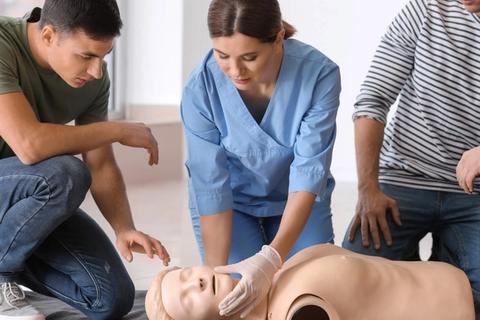
This 1 day Qualsafe accredited course provides comprehensive training designed to equip employees with essential first aid skills tailored for low risk working environments, ensuring employer compliance with the Health and Safety (First Aid) Regulations 1981. Your trainer is a Registered Nurse with many years of clinical experience within Emergency Departments who trains Advanced Life Support to medical and nursing staff in acute hospital environments. Group bookings from £60.00 per person.
Northwich Training Centre, Northwich
2 spots left · 5 dates available
FAW Blended 3 Day Course
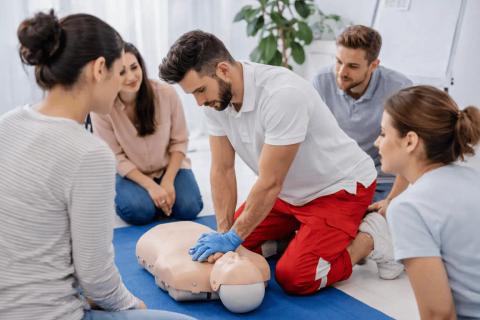
This 3 day blended Qualsafe accredited course — Day 1 completed online as e-Learning, Days 2 and 3 classroom based — provides comprehensive training designed to equip employees with essential first aid skills tailored for high risk working environments, ensuring employer compliance with the Health and Safety (First Aid) Regulations 1981. Your trainer is a Registered Nurse with many years of clinical experience within Emergency Departments.
On-site or at our training centre
We deliver on-site first aid training at Sandbach workplaces for groups. We also run scheduled courses throughout the year at our training centre at First Floor, 2 Queen Street in Northwich, about a 20 minute drive from Sandbach. Check the live dates on our Emergency First Aid at Work page or our First Aid at Work page.
Need help with your assessment?
If you are a Sandbach employer and you are not sure whether your current first aid arrangements are adequate, give us a call on 07958 915146. We can talk through your situation and help you work out what training your team needs. The assessment does not take long, but it is the foundation of everything else. Get it right, and the rest falls into place.
Topics

Written by
Founder
- Registered Nurse / Specialist Practitioner Emergency Care
- Advanced Paediatric Life Support Instructor
- Immediate Life Support Instructor
- Independent Non Medical Prescriber
- Post Graduate Certificate in Education
I have practiced as a registered nurse for over 34 years, 29 within a senior nursing position within Emergency Care and as a part time lecturer at the University of Manchester. I am a Resuscitation Council (UK) and Advanced Life Support Group Instructor for Advanced Paediatric…
Read more about Jennie

