








You completed your BLS training six months ago. You felt confident when you left the course. The compressions were at the right depth, the AED sequence was clear in your head, and you knew you could manage a cardiac arrest if it happened. Fast forward to today, and you are not quite so sure. The steps feel a little fuzzy. You cannot quite remember whether you check breathing before or after tilting the head. The confidence has faded.
This is completely normal. Life support skills are perishable. Research consistently shows that CPR quality declines within three to six months of training, even among healthcare professionals who completed the course to a high standard. The skills do not disappear overnight, but they erode gradually until the gap between what you learned and what you can actually do in an emergency becomes significant.
For healthcare and dental teams in Middlewich, where life support skills could be needed at any moment, keeping those skills current between annual refreshers is not just good practice. It is a professional responsibility.
We are PCT Services, and we deliver Resuscitation Council UK accredited life support training from our training centre at First Floor, 2 Queen Street in Northwich, about a 5 minute drive from Middlewich. We also deliver on-site training at healthcare settings across the area.
Why skills fade
The reason is straightforward. Life support is a practical, psychomotor skill. Like driving, swimming, or playing a musical instrument, it requires regular practice to maintain. The difference is that most people drive every day, but most healthcare professionals perform CPR very rarely. The gap between training sessions is long, and the opportunities to practise in real life are, thankfully, infrequent.
The specific skills that fade fastest are compression quality and ventilation technique. Studies show that compression depth becomes shallower, compression rate becomes less consistent, and the coordination between compressions and ventilations becomes less smooth as time passes. AED competence tends to remain relatively stable because the device provides prompts, but the confidence to retrieve and apply it quickly can still decline.
For dental teams in Middlewich, where the risk of a medical emergency during sedation or invasive procedures is real, this skill fade is a genuine clinical safety concern. For GP surgeries and care homes, where patients may deteriorate rapidly, the same applies.
Annual refreshers are the minimum
The Resuscitation Council UK recommends annual BLS refreshers for all healthcare staff. The CQC and GDC expect to see evidence of current training. Our BLS course is a two hour session that covers all the core skills: recognition of cardiac arrest, high-quality compressions, rescue breathing, AED use, and choking management. It follows the latest Resuscitation Council UK guidelines and uses manikins with real-time feedback.
Annual refreshers are the minimum standard, and they are essential. But a single two hour session once a year may not be enough to maintain peak readiness, especially for staff who are unlikely to encounter a real cardiac arrest between training sessions.
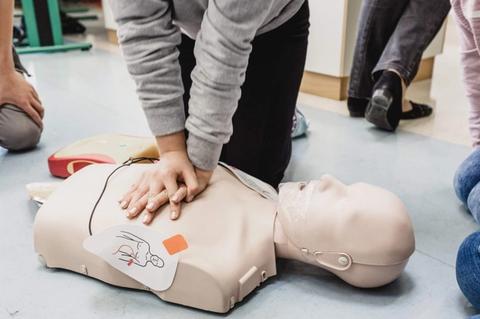
Basic Life Support Training (BLS)
This Basic Life Support is ideal for healthcare professionals who require Level 2 Resuscitation Core Skills Training Framework (CSTF). This CPD accredited course provides essential knowledge and practical skills to competently recognise a cardiac arrest and commence basic life support in adults, children and infants. It also covers safe application of an AED (Automatic External Defibrillator), how to use a Bag-Valve-Mask (BVM), administration of oxygen, and the initial assessment and management of anaphylaxis and choking.
Northwich Training Centre, Northwich
4 spots left · 3 dates available
What you can do between refreshers
Monthly team drills
The most effective healthcare teams we work with run brief, informal practice sessions between annual refreshers. This does not need to be a formal training event. It can be as simple as getting the practice manikin out during a quiet period, running through the CPR sequence for ten minutes, and then putting it away.
If your Middlewich dental practice or GP surgery does not have a practice manikin, consider investing in one. Basic CPR manikins are available for a few hundred pounds and last for years. The return on that investment, in terms of team readiness, is enormous.
Scenario discussions
Even without a manikin, you can maintain mental readiness by running through scenarios as a team. What would you do if a patient collapsed in the waiting room right now? Who would start CPR? Who would call 999? Who would get the AED? Where is the AED? When was it last checked?
These discussions take five minutes and can be done during a team meeting or a quiet moment. They keep the response plan fresh in everyone's minds and identify any gaps before a real emergency exposes them.
Individual skills review
Between refreshers, individual healthcare professionals can review their BLS skills through a variety of resources. The Resuscitation Council UK website provides guidelines, algorithms, and educational materials. Short refresher videos can reinforce the correct techniques. But nothing replaces hands-on practice, which is why the annual refresher course is non-negotiable.
eILS for clinical staff
For clinical staff in Middlewich who need more advanced skills, our enhanced Immediate Life Support course goes beyond BLS. It covers airway management with adjuncts, bag-valve-mask ventilation, recognition of peri-arrest arrhythmias, and a structured ABCDE assessment of the deteriorating patient.
eILS costs £180 per person and combines e-learning with a full day of practical, simulation-based training. For GPs, practice nurses, dentists, and senior dental nurses, eILS provides the additional skills to manage a medical emergency at a higher level while waiting for the ambulance.
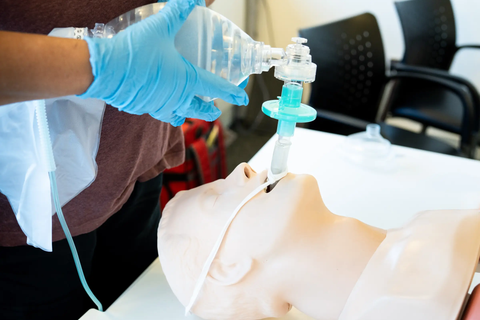
Immediate Life Support Training (eILS)
The Immediate Life Support course is a specialised course designed to equip healthcare professionals with a variety of skills, from managing a deteriorating adult, identifying causes of deterioration and treating cardiorespiratory arrest in adults, to developing team leadership skills and understanding what it takes to be an effective team member in an emergency.
Northwich Training Centre, Northwich
Fully booked
Building a training rhythm for your team
The most effective approach is to build life support training into the fabric of your team's working year.
Book annual BLS refreshers for the whole team. Pick the same month each year so it becomes a routine part of your calendar. Our training centre is a 5 minute drive from Middlewich, and we run BLS courses throughout the year. Check the live dates on our Basic Life Support page.
Book eILS for your clinical staff on a regular cycle. The course provides a deeper level of competence that complements the annual BLS refresher.
Run brief practice drills monthly or quarterly. These do not need to be formal or lengthy. Ten minutes with a manikin or five minutes discussing a scenario keeps skills and awareness alive.
Check your AED quarterly. Battery charged, pads in date, location clearly marked, all staff aware of where it is.
On-site training for Middlewich practices
For dental practices, GP surgeries, and care homes in Middlewich, on-site BLS training is the most practical option. We come to your premises, train your team in batches around your clinic schedule, and reference your specific equipment and procedures during the session. The proximity of our Northwich centre, just 5 minutes away, also makes it easy for individuals to attend scheduled courses.
Book your training
Check the upcoming dates on our Basic Life Support page or our eILS page. Or give us a call on 07958 915146 to arrange on-site training for your Middlewich team. Life support skills save lives, but only if they are current. Keep your team ready.
Topics

Written by
Founder
- Registered Nurse / Specialist Practitioner Emergency Care
- Advanced Paediatric Life Support Instructor
- Immediate Life Support Instructor
- Independent Non Medical Prescriber
- Post Graduate Certificate in Education
I have practiced as a registered nurse for over 34 years, 29 within a senior nursing position within Emergency Care and as a part time lecturer at the University of Manchester. I am a Resuscitation Council (UK) and Advanced Life Support Group Instructor for Advanced Paediatric…
Read more about Jennie

