




















If you run a nursery in Macclesfield, you have probably heard the term Level 3 Paediatric First Aid. You know you need it for EYFS compliance, and you know Ofsted will ask about it. But what exactly is it, what does it cover, and why is the full Level 3 qualification the one your nursery needs rather than a shorter or cheaper alternative?
These are questions we get asked regularly by nursery managers and owners across Macclesfield and the wider area. The answer matters, because the qualification your staff hold directly affects whether your setting is compliant, whether your team is genuinely prepared for a paediatric emergency, and whether parents can trust that their children are in safe hands.
We are PCT Services, and we deliver Qualsafe Awards accredited paediatric first aid training from our training centre at First Floor, 2 Queen Street in Northwich, about a 25 minute drive from Macclesfield. We work with nurseries of all sizes and can deliver training at our centre or on site at your Macclesfield nursery.
What Level 3 Paediatric First Aid means
Level 3 refers to the qualification level on the Regulated Qualifications Framework (RQF). A Level 3 qualification is pitched at the same level as an A-Level, meaning it requires a deeper understanding and a broader range of skills than a Level 2 or emergency-only course.
Our Paediatric First Aid (2 Day) course is a Level 3 Qualsafe Awards accredited qualification. It combines one day of e-learning with one day of practical classroom training, giving your staff both the theoretical knowledge and the hands on skills to manage paediatric emergencies confidently and competently.
This is the qualification that the EYFS statutory framework specifies. When Ofsted inspectors visit your nursery, this is what they expect to see on your staff's certificates. A shorter or lower level course may teach some useful skills, but it will not meet the EYFS requirement, and that puts your nursery at risk.
What the course covers
The full Level 3 Paediatric First Aid course is comprehensive. It covers significantly more than just the basics, which is why it takes two days rather than one.
Your staff will learn infant and child CPR, with extensive practice on age-appropriate manikins. They will learn to manage a choking infant and a choking child, using the correct techniques for each age group. The course covers how to deal with an unconscious but breathing child, including the recovery position adapted for infants.
Beyond the immediate life-threatening emergencies, the course covers a wide range of paediatric scenarios that nursery staff need to be prepared for. Burns and scalds, which are one of the most common injuries in early years settings. Febrile convulsions, which can happen suddenly and are terrifying to witness if you do not know what is going on. Anaphylaxis and severe allergic reactions, which are increasingly common in children. Meningitis and its signs. Head injuries from falls. Fractures and sprains. Bleeding and wound management. Bites and stings. Foreign objects in the nose, ears, or eyes. And the effects of heat and cold.
The practical day gives your staff extensive hands on practice with manikins and scenario based exercises. They do not just hear about these things. They practise responding to them, which is what builds genuine confidence.
Why the full Level 3 matters more than a shorter course
There are shorter courses available that cover some paediatric first aid content. The Emergency Paediatric First Aid course, for example, is a one day course that covers the core emergencies. It is a good course, and it is suitable for some settings. But for nurseries, the full Level 3 course is the right choice, and here is why.
The EYFS statutory framework requires at least one person on the premises with a full paediatric first aid qualification at all times when children are present. The full Level 3 course is the qualification that meets this requirement without ambiguity.
The deeper coverage means your staff are prepared for a wider range of scenarios. In a nursery, children are active, curious, and unpredictable. The emergencies you might face go beyond choking and CPR. Your staff need to know what to do when a child has a seizure, when a toddler pulls a hot drink over themselves, when a child has a severe allergic reaction at lunchtime, or when a baby shows signs of meningitis. The full course covers all of these and more.
It also builds greater confidence. A one day course gives your staff a foundation, but the two day course gives them the time to practise, ask questions, work through scenarios, and leave feeling genuinely ready. And confidence matters. In an emergency, hesitation costs time, and time costs outcomes.
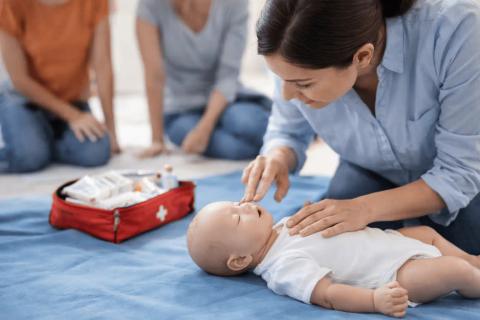
Paediatric First Aid (2 Day) *OFSTED & EYFS*
This Qualsafe Level 3 Award in Paediatric First Aid (RQF) is a regulated and nationally recognised qualification which is OFSTED and EYFS compliant. Your trainer is a Registered Nurse with many years of clinical experience within Emergency Departments who trains Advanced Paediatric Life Support to medical and nursing staff in acute hospital environments.
Northwich Training Centre, Northwich
Fully booked · 4 dates available
How many Level 3 first aiders does your nursery need?
The minimum requirement is one person on the premises at all times. But in practice, most nurseries in Macclesfield need more than one. You need to consider staff absences, shift patterns, lunch breaks, outdoor play supervision, and the physical layout of your setting. If your one trained first aider is in the baby room and a child in the pre-school room starts choking, you have a problem.
Our recommendation is to have at least one Level 3 trained first aider per room, plus one or two additional staff trained as backup. This gives you full coverage throughout the day, even when people are off sick or on holiday.
You also need to think about certificate expiry. The Level 3 qualification is valid for three years. If you have three trained staff and two of their certificates expire in the same month, you could be left with only one qualified person. Stagger your training dates so that certificates renew at different times throughout the year.
Training at your Macclesfield nursery or our Northwich centre
We can deliver the Level 3 Paediatric First Aid course on site at your nursery in Macclesfield. We bring all the equipment, including infant and child manikins, and set up wherever works best. On site training means your staff do not need to travel, and you can train a group together, which is great for team confidence and consistency.
Your staff can also attend one of our scheduled courses at First Floor, 2 Queen Street in Northwich. Check the live dates on our Paediatric First Aid page and book directly.
If you need the one day Emergency Paediatric First Aid course for additional staff who do not require the full Level 3, check our Emergency Paediatric First Aid page. And if you want dual adult and paediatric certification for staff who also need workplace first aid cover, our Combined Emergency First Aid at Work and Paediatric First Aid page has the details.

Emergency Paediatric First Aid
The Qualsafe Level 3 Award in Emergency Paediatric First Aid (RQF) is a regulated and nationally recognised qualification. Your trainer is a Registered Nurse with many years of clinical experience within Emergency Departments who trains Advanced Paediatric Life Support to medical and nursing staff in acute hospital environments.

Combined Emergency First Aid at Work and Emergency Paediatric First Aid
This combined Qualsafe Level 3 Award in Emergency First Aid at Work (RQF) and Emergency Paediatric First Aid (RQF) is a regulated and nationally recognised qualification and is HSE and OFSTED compliant. Your trainer is a Registered Nurse with years of experience in Emergency Departments who trains Advanced Life and Advanced Paediatric Support to medical and nursing staff in acute hospital environments.
Northwich Training Centre, Northwich
Fully booked · 4 dates available
Book your training
If you manage a nursery in Macclesfield and you want to make sure your paediatric first aid provision is exactly where it needs to be, give us a call on 07958 915146 and we can talk through your staffing, your current certificates, and the best training plan for your setting. Or check the upcoming dates on our course pages and book directly. Your children's safety depends on it.
Topics

Written by
Founder
- Registered Nurse / Specialist Practitioner Emergency Care
- Advanced Paediatric Life Support Instructor
- Immediate Life Support Instructor
- Independent Non Medical Prescriber
- Post Graduate Certificate in Education
I have practiced as a registered nurse for over 34 years, 29 within a senior nursing position within Emergency Care and as a part time lecturer at the University of Manchester. I am a Resuscitation Council (UK) and Advanced Life Support Group Instructor for Advanced Paediatric…
Read more about Jennie

